
HOW WE GOT STARTED AT TANHURST
CULTIVATING OUR WINE BUSINESS
Our vineyard is located on the main farm on the Tanhurst Estate, Birketts Farm. The land here slopes gently southwards and the underlying geology changes from the greensand of Leith Hill to the clay of The Weald.
AN IDEAL LOCATION FOR AN ENGLISH VINEYARD
We sought the professional advice and guidance of a leading viticulturist to help us establish if our land was suitable for growing grapes. Our main priority was to ensure that we had the right location as the fields need to face the right direction, on a slope preferably with some degree of protection from the weather. Our location and soil proved to be ideal for nurturing the vines that would help us produce beautiful natural English wines.
As new English vineyard owners it has been important for us to learn our craft and trade from experts in the wine industry.
EARLY DAYS ESTABLISHING THE VINEYARD
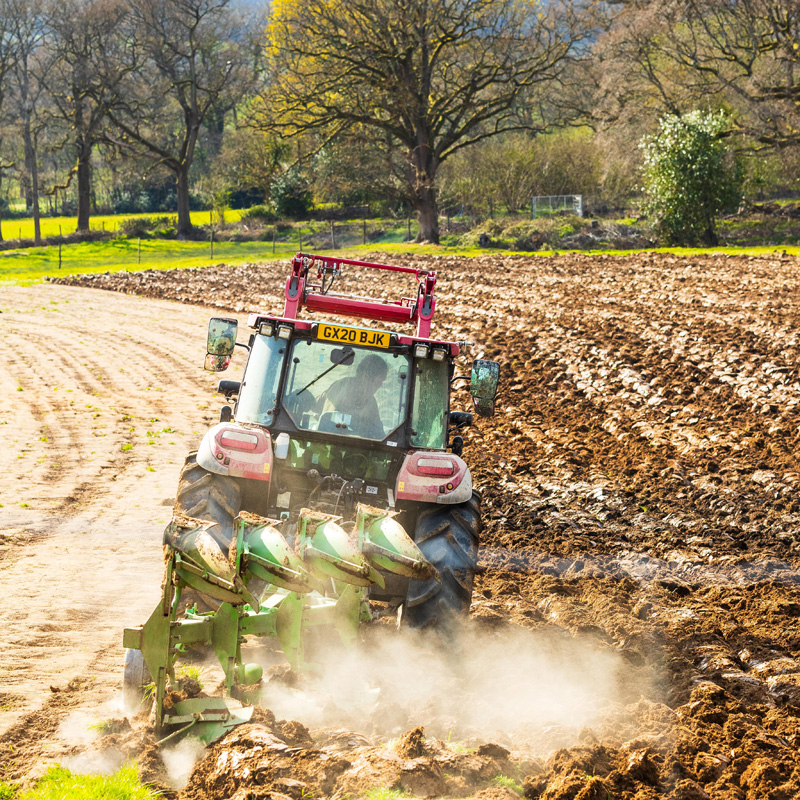
Our vineyard began in 2020 with the decision to plant four and a half acres of Pinot Noir. So, in the beginning of the year, we ploughed and harrowed the first field to prepare the soil for planting the vines. We ploughed the fields on three occasions and then power harrowed them twice. Power harrows break up the soil, refining and evenly distributing it to create a perfect soil for planting the vines.
The second task was for us to clear out the existing overgrown ditches around each field to maximise drainage. This is vital as vines prefer well drained soil, it also makes for better working conditions when using the machinery in the vineyard.
Our third main task was to install deer fencing around the perimeter of all three fields. This type of fencing is primarily to keep local wildlife out, specifically badgers, rabbits and roe deer. We sourced locally made sweet chestnut timber posts and reinforced the stock fencing with rabbit netting. This is partially buried in the ground to stop rabbits from digging under the fence.
THE PLANTING BEGINS
Then in the spring, our first 8,000 Pinot Noir vines were planted by an expert team from Germany using specialist machinery with GPS navigation for precise planting in perfectly straight lines.
The planting machine incorporates tractor with a specially designed attachment where the planting team sit. They feed the individual vines into the planting wheel which drops into the pre-drilled channel in the soil. There is a device which then back fills the soil around the vine to complete the planting process. The planting took a whole day to complete. The vines were spaced at 1.2 metres apart in uniform rows 2.2 metres apart to ensure they would get optimum sunlight from our English climate.

NURTURING THE VINES IN
ALL WEATHER
All the family and our team of workers then spent several days adding the stakes and tubes to each vine to protect them and encourage their growth during the early stages. Vines need to be nurtured carefully for the first three years, so they build a strong supporting trunk and root structure. After this period the first grapes can be harvested.
Weather is the main challenge to yield in England. It is said that in every three years, there will be good year, one average year and one bad year. You can lose a crop due to a frost in late spring or continuous heavy rain in June, and you need a warm ripening period in late summer.
BUILDING OUR OWN WINERY ON SITE
We knew we wanted to build a winery so we could produce our own wine on site. So, while we waited for the vines to mature sufficiently to produce our first harvest, we set about converting one of our old, abandoned barns. Our intention is to produce a selection of excellent quality artisan sparkling, still red and rosé wines.
A winery is a complex facility and Colin undertook a great deal of careful planning to make sure it will function as well as it can. In addition to being well-equipped the winery must be easy to clean and maintain, and durable enough to cope with varying temperatures, wear and tear as well as heavy loads from the wine-making equipment.
PLANTING MORE FIELDS
After the Pinot Noir, we planted a further 12,000 vines in spring 2021, including superior clones of Chardonnay, Pinot Meunier and Pinot Noir Précoce. More planting followed in 2023 with two further fields of Cabernet Cortis and Sauvignon Blanc, which will come into production in the autumn of 2026.